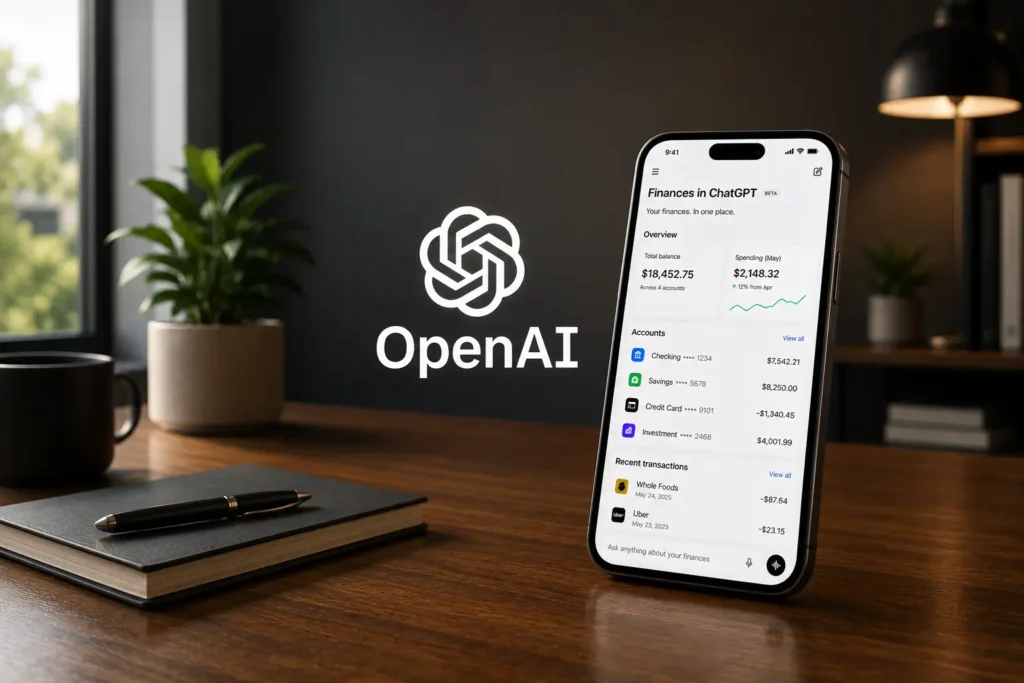
OpenAI has unveiled its most sensitive integration to date with the rollout of native personal finance tracking tools directly inside ChatGPT. Currently operating as a limited preview for premium ChatGPT Pro subscribers on web and iOS platforms, the feature follows OpenAI’s quiet acquisition of AI-driven personal CFO startup Hiro earlier this year, signaling an aggressive push to morph the conversational interface into a central utility hub for daily life.
The system relies on backend architecture provided by financial API pioneer Plaid to establish read-only data pipelines with major banking, fintech, and brokerage ecosystems—including Chase, Fidelity, Capital One, and Robinhood. Once linked via the new “Finances” sidebar command, ChatGPT auto-populates a visual telemetry hub breaking down month-on-month category expenditures, upcoming household utility bills, and cryptocurrency or equity distribution metrics. Users can then ask open-ended, natural language questions such as querying if their discretionary spending has spiked over a rolling 30-day window, or requesting step-by-step savings pathways geared toward long-term real estate investments based on their actual cash flow.
To handle the granular, context-heavy data streams securely, the deployment relies on OpenAI’s current-generation GPT-5.5 engine. The model has been fine-tuned against a custom financial reasoning benchmark developed alongside fifty industry compliance professionals to minimize logical errors and lower factual hallucination rates. Furthermore, the assistant introduces specialized “financial memories,” permitting the neural network to retain explicit personal parameters—like independent savings goals or pending mortgage debts—across distinct chat threads without treating subsequent analytical requests in isolation.
Addressing data governance and privacy concerns, OpenAI has emphasized that the integration is strictly read-only; the AI assistant does not have visibility over full account numbers, nor can it execute trades, transfer capital, or modify retirement contribution distributions. Users maintain granular control over their information via a centralized settings panel, allowing them to manually erase saved financial memories or revoke Plaid access entirely. Once an account is officially unlinked, OpenAI’s corporate policy mandates that all synced transactional history and cache logs must be completely purged from company servers within a strict 30-day window.